What a Balance Sheet is
The Balance Sheet is a snapshot. It shows, at a single moment in time, what your business owns (assets), what it owes (liabilities), and what's left over for the owners (equity).
The fundamental rule:
Assets = Liabilities + Equity
Always. That's why it's called "balance" sheet. The two sides must balance.
If you took everything your business owns and sold it, then paid off everything you owe, what's left is the owners' equity. That's your stake in the business.
How to run it in BitBooks
- Click Reports in the left sidebar
- Click Balance Sheet
- Pick an "as of" date (default: today)
The report renders.
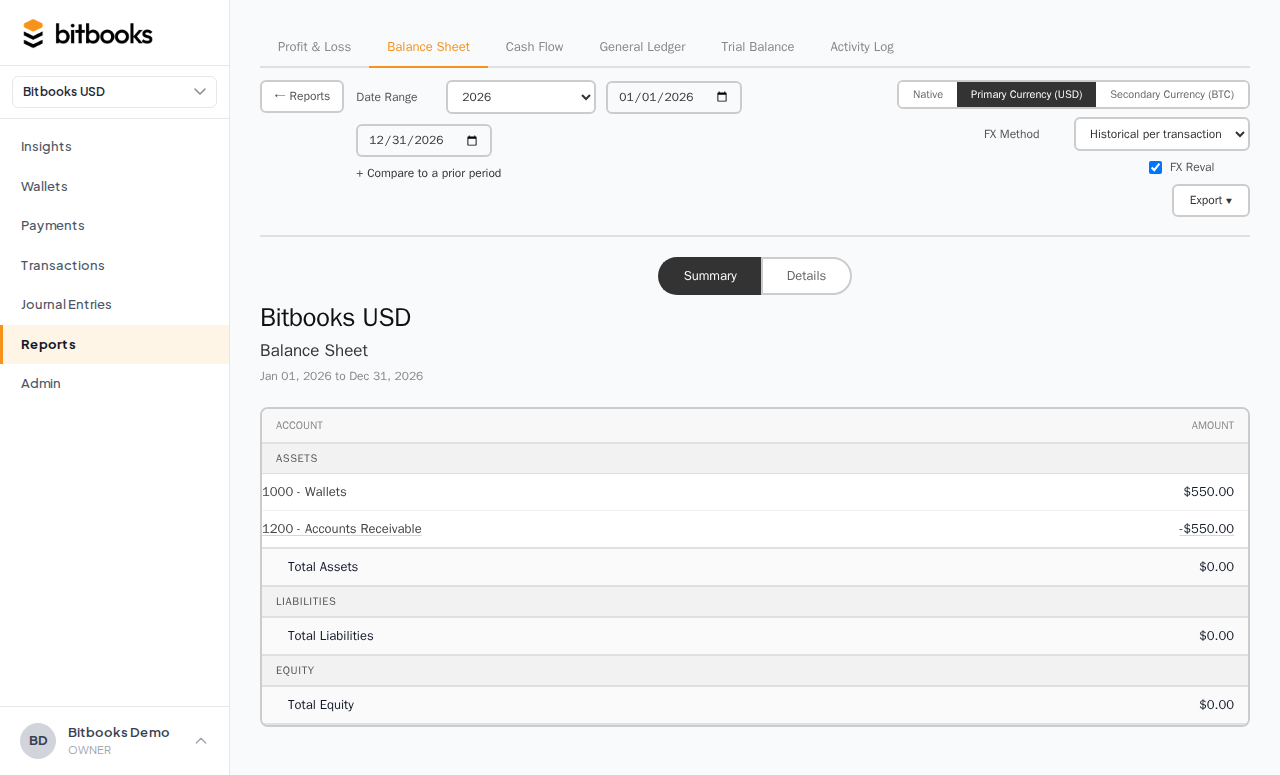
What the report shows
A typical Balance Sheet:
ASSETS
  Current Assets
    Cash on Hand                        $5,200.00
    BTC Hot Wallet                      $9,000.00
    BTC Cold Storage                   $40,000.00
    Accounts Receivable                 $2,500.00
    ─────────────────────────────────────────────
    Total Current Assets               $56,700.00

  Fixed Assets
    Office Equipment                    $3,000.00
    Vehicles                            $8,000.00
    ─────────────────────────────────────────────
    Total Fixed Assets                 $11,000.00

  ─────────────────────────────────────────────
  TOTAL ASSETS                         $67,700.00

LIABILITIES
  Current Liabilities
    Accounts Payable                    $1,200.00
    Credit Card                           $850.00
    ─────────────────────────────────────────────
    Total Current Liabilities           $2,050.00

  Long-Term Liabilities
    Equipment Loan                      $5,000.00
    ─────────────────────────────────────────────
    Total Long-Term Liabilities         $5,000.00

  ─────────────────────────────────────────────
  TOTAL LIABILITIES                     $7,050.00

EQUITY
  Owner's Capital                      $25,000.00
  Retained Earnings                    $35,650.00
  ─────────────────────────────────────────────
  TOTAL EQUITY                         $60,650.00

─────────────────────────────────────────────────
TOTAL LIABILITIES + EQUITY             $67,700.00
The two TOTAL rows ($67,700 in this example) must be equal. That's the balance check. If they're not equal, there's a data integrity problem (run the Trial Balance to investigate).
The three sections explained
Assets (what you own)
Anything of value the business has:
- Current assets. Things you can convert to cash within a year. Bank accounts, Bitcoin wallets, accounts receivable, inventory.
- Fixed assets. Long-term things. Computers, vehicles, equipment, real estate.
- Other assets. Less common categories: prepaid expenses, deposits, intangibles.
For a Bitcoin business, both your fiat bank accounts AND your BTC wallets show up here. They're both assets. The BTC value displayed is the dollar (or functional currency) equivalent at the as-of date.
Liabilities (what you owe)
Anything the business owes to others:
- Current liabilities. Due within a year. Accounts payable (vendor bills), credit cards, short-term loans, taxes owed.
- Long-term liabilities. Due more than a year out. Equipment loans, mortgages, long-term debt.
Equity (what's left for the owners)
The difference between assets and liabilities. This is the owners' stake.
Equity has two main pieces:
- Owner's capital (or "paid-in capital"). Money the owners put into the business at startup or in subsequent investment rounds.
- Retained earnings. All the profit the business has made minus any owner draws or dividends. The accumulated history of profits.
If your business made $35,000 in profit since founding, kept all of it in the business, and the owners originally put in $25,000, equity is $60,000. That's their stake.
The "as of" date matters
A Balance Sheet shows what you own and owe at one specific moment. Pick that moment carefully:
- Today. What does the business look like right now?
- End of last month. Where did we stand at month-end?
- End of last year. Year-end Balance Sheet for tax filings or annual reports.
- A specific historical date. Maybe an investor wants to see Balance Sheet on the day they invested.
Change the as-of date at the top of the report.
Comparing two dates (start vs end of period)
To see how the Balance Sheet changed during a period:
- On the Balance Sheet page, find the Compare dropdown
- Pick a comparison date
- The report shows two columns and a change column
This is how investors and lenders read your Balance Sheet. They want to see whether it's improving (more assets, less debt, more equity) or declining.
Drilling into a number
Same as the P&L. Click any number on the Balance Sheet to see the transactions behind it.
Click on "BTC Hot Wallet: $9,000.00" and you'll see every transaction in that wallet up to the as-of date. Useful when a number looks wrong.
Bitcoin on the Balance Sheet
If you hold Bitcoin, it appears under Assets. The value shown is the BTC balance times the exchange rate at the as-of date.
Important: the rate is the rate at the as-of date, not the rate when you acquired the BTC. So if you bought BTC at $50,000 each and the price is now $80,000, your Balance Sheet reflects the $80,000 value, not the $50,000 cost.
The difference between cost and market value is an unrealized gain (or loss). For accurate accounting, you should periodically run an FX revaluation to formally book those changes. See Tracking Bitcoin Value Changes.
Without revaluations, your Balance Sheet still shows current market value, but the offsetting entry isn't formally journalized. Most small Bitcoin businesses run revaluations at year-end. Larger or audited businesses run them monthly or quarterly.
What the Balance Sheet does NOT show
- Whether you made money this period. That's the P&L.
- The history of changes. Balance Sheet is a snapshot, not a movie. To see how things changed, run two Balance Sheets at different dates and compare, or look at the Cash Flow Statement.
- Draft entries. Drafts are excluded.
Common questions
"Why is my equity so high?"
Equity grows whenever the business makes a profit and the owners don't take it out. If you've been profitable for years and haven't paid yourself dividends, equity will be a big number. That's a good thing: it means the business has built up value.
"My Balance Sheet doesn't balance."
This should never happen. If it does, run the Trial Balance to confirm debits = credits. If Trial Balance is fine but Balance Sheet is off, contact support. There's a data integrity issue we need to investigate.
"What's 'Net Income' doing on the Balance Sheet?"
You might see a "Net Income" or "Current Year Earnings" line in the Equity section. That's the profit from the current period (year-to-date), which hasn't yet been rolled into Retained Earnings. At year-end close, this number gets transferred to Retained Earnings and resets to zero for the new year.
Where to go next
- Profit & Loss Report for the period view of revenue and expenses
- Cash Flow Statement for how cash moved during the period
- Tracking Bitcoin Value Changes for proper Bitcoin revaluation accounting
- Period Close for year-end procedures