The problem
You bought 2 BTC for $50,000 each in January. Total cost: $100,000.
By December, BTC is at $80,000. Your 2 BTC is now worth $160,000.
You haven't sold anything. No transaction happened. But the value of what you own has changed by $60,000.
How should that show up in your books? Most accounting tools have no answer. They record the original $100,000 and never update it. Your year-end Balance Sheet says you own $100,000 of Bitcoin. Your investor looks at the news, sees BTC at $80,000, does the math: 2 BTC × $80,000 = $160,000. They ask "why does your Balance Sheet show $100,000?"
That gap is the problem. BitBooks closes it through a feature called FX revaluation.
What FX revaluation does
FX revaluation is a periodic accounting action that:
- Looks at every Bitcoin balance you hold
- Compares the recorded value to the current market value
- Books the difference as an unrealized gain or unrealized loss
After revaluation, your Balance Sheet shows the current market value, your P&L shows the gain or loss, and your books reflect economic reality.
The "FX" in "FX revaluation" stands for foreign exchange. The same logic applies to any non-functional currency, but for most users it's specifically Bitcoin.
Realized vs unrealized
Two important terms:
- Unrealized gain/loss. The change in value of something you still own. Hasn't actually been "captured" because you haven't sold. Could go up or down again before you do.
- Realized gain/loss. The change in value when you actually sell. The transaction that locks in the dollar amount.
Both belong on the books, but they're different categories.
A simple example: you bought 1 BTC at $50,000. BTC is now $70,000. If you do nothing, you have an unrealized gain of $20,000. If you sell that BTC at $70,000, the $20,000 is now realized.
FX revaluation handles the unrealized side. The act of selling produces realized gains/losses through ordinary transaction entries (BitBooks calculates the gain when you record the sale).
How often to revalue
The common cadence:
- Year-end. Mandatory for accurate annual financials. Most small businesses do only this.
- Quarterly. Common for businesses that report to investors quarterly.
- Monthly. Common for businesses with significant Bitcoin holdings or audited financials.
- Daily. Rare. Some Bitcoin treasuries do this.
The more often you revalue, the more "live" your Balance Sheet feels. The trade-off is more entries to manage.
A good default for a small business: revalue once a year at year-end, plus an extra revaluation right before any major event (investor pitch, bank loan application, board meeting).
How to run a revaluation in BitBooks
- Go to Admin → FX Revaluation (or look for the Revaluations action in the Reports menu)
- Pick the as-of date (the date the new values reflect)
- Optionally pick the method:
- Closing rate (use the rate at the as-of date, applied to all balances): the standard
- Period average (use the average rate over the period): less common, mostly for income translation
- Historical per transaction (each transaction stays at its original rate): the default for transactions; revaluation overrides this only on year-end positions
- Pick the framework: IFRS or US GAAP. They handle some details differently. Default matches your organization's setting.
- Click Preview
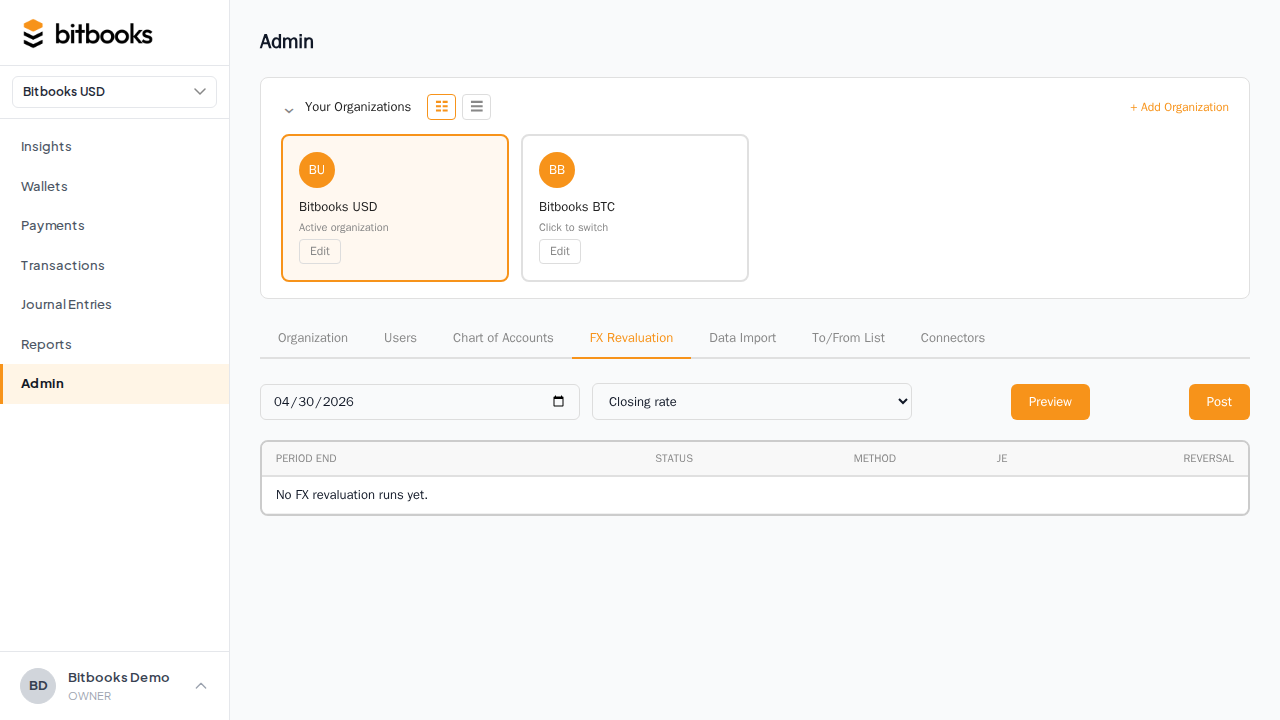
Preview shows what will happen
The preview lists every Bitcoin balance, the recorded value, the new value at the as-of date, and the proposed gain or loss. You can review before committing.
Bitcoin Hot Wallet
  BTC balance:        0.50 BTC
  Recorded value:     $32,000.00
  Market value:       $40,000.00
  Unrealized gain:    +$8,000.00

Bitcoin Cold Storage
  BTC balance:        2.00 BTC
  Recorded value:    $100,000.00
  Market value:      $160,000.00
  Unrealized gain:   +$60,000.00

TOTAL UNREALIZED GAIN:  +$68,000.00
If the preview looks right, click Post Revaluation. BitBooks creates a journal entry that books the gain to a special account ("Unrealized FX Gain on Bitcoin" or similar) and updates the Bitcoin balance to current market value.
After posting
The revaluation creates a Posted journal entry (you can see it in Journal Entries). Your reports update:
- Balance Sheet: Bitcoin now shows current market value
- P&L: An "Unrealized FX gain" line shows the impact for the period
Subsequent transactions continue normally. The revaluation is a one-time correction; it doesn't keep updating in real time.
Reversing a revaluation
If you ran a revaluation by mistake, or with the wrong as-of date:
- Go to the FX Revaluation page
- Find the run in the history
- Click Reverse Revaluation
This creates a reversing entry that exactly cancels the revaluation. Both stay in the audit trail. You can then run a corrected revaluation.
Some accounting framework details
A few things differ between IFRS and US GAAP:
| Topic | IFRS | US GAAP |
|---|---|---|
| Bitcoin classification | Indefinite-lived intangible (often) or financial asset (sometimes) | Indefinite-lived intangible asset (mostly) |
| Unrealized gains | Generally recognized in P&L | Historically not recognized; only impairment was. Updated guidance now allows fair value. |
| Currency translation | Per IAS 21, with specific rules for monetary vs non-monetary items | Per ASC 830 |
If you're under US GAAP and your accountant follows older guidance ("Bitcoin can only be marked down, not up"), you'd revalue only when there's a loss. That's the conservative interpretation.
If you follow newer guidance (FASB ASU 2023-08), you can mark Bitcoin to fair value. Most BitBooks users are on this path.
If you're under IFRS, it depends on your classification. Most Bitcoin businesses classify under IAS 38 and revalue with gains and losses going through P&L.
The framework affects which BitBooks tools you should use. Pick your organization's framework in Admin → Settings, and ask your accountant if you're uncertain.
What revaluation does NOT do
- It doesn't predict the future. The revalued amount is current at the as-of date. It will be different tomorrow as Bitcoin's price moves. That's why you re-revalue periodically.
- It doesn't sell your Bitcoin. No actual transaction happens at your wallet. The Bitcoin amount in the wallet is unchanged. Only its dollar-equivalent on your books changes.
- It doesn't apply to fiat currencies you operate in. If you have a CAD account and your functional currency is USD, the CAD/USD conversion happens through the normal exchange rate mechanism per transaction. Revaluation is mainly for Bitcoin and other foreign currency holdings at the snapshot moment.
Common questions
"My Bitcoin price dropped. Do I have to recognize the loss?"
Under most frameworks, yes. Unrealized losses should be recognized through revaluation just like gains. Run the revaluation, the loss appears as a negative on your P&L.
A loss is unpleasant to see, but recognizing it is the honest answer. Hiding it inflates your apparent equity and would mislead anyone reading the financials.
"What if I don't run revaluation? What's the worst that happens?"
Your Balance Sheet shows the wrong Bitcoin value. Reports look incorrect to anyone who knows what BTC is currently worth. Tax filings might be incorrect (depending on jurisdiction). For a hobby account, low stakes. For a business with serious Bitcoin holdings, real consequences.
"My accountant says we should only revalue at year-end."
Then revalue at year-end. The annual cycle satisfies most regulatory and tax requirements. Mid-year revaluations are optional and mostly for stakeholder communication.
"How does this interact with selling Bitcoin?"
When you sell, you record an ordinary transaction. The gain or loss on that sale is the difference between the sale price and the most recent revalued amount, not the original purchase price. This is correct because revaluation already booked the unrealized portion. Selling just realizes the rest.
If you've never revalued, the gain/loss on sale is the difference between sale price and original cost. That's also correct. The two approaches just put the gain in different periods.
Where to go next
- The Three-Currency Model Explained for the multi-currency foundation
- How Exchange Rates Work in BitBooks for where prices come from
- Period Close for when revaluations should run as part of close
- Profit & Loss Report to see the impact of revaluation on income
- Balance Sheet to see Bitcoin at current market value after revaluation