What a Trial Balance is
A Trial Balance is the simplest possible health check for an accounting system. It does one thing: it adds up every debit in the entire system, adds up every credit, and shows you that they're equal.
In double-entry bookkeeping, debits and credits must always be equal. That's the rule. If they're not equal, something is broken: a transaction was saved without both sides, a calculation went wrong, a database glitch corrupted a record. The Trial Balance is how you catch this kind of problem.
It's like checking that your cash drawer balances at the end of the shift. You count the cash, compare to what the register says, they should match. If they don't, something's wrong.
Every accounting tool since the invention of accounting has this report. BitBooks does too.
When to run it
- At month-end, before you close the period
- After importing data from QuickBooks, CSV, or any bulk source
- When numbers look wrong in any other report
- Whenever the Insights page shows a red "ledger health" icon
- As a final sanity check before sending reports to your accountant or tax preparer
It takes about 5 seconds to run.
How to run it
- Click Reports in the left sidebar
- Click the Trial Balance tab
- Pick the date range (default: year to date)
- The report renders
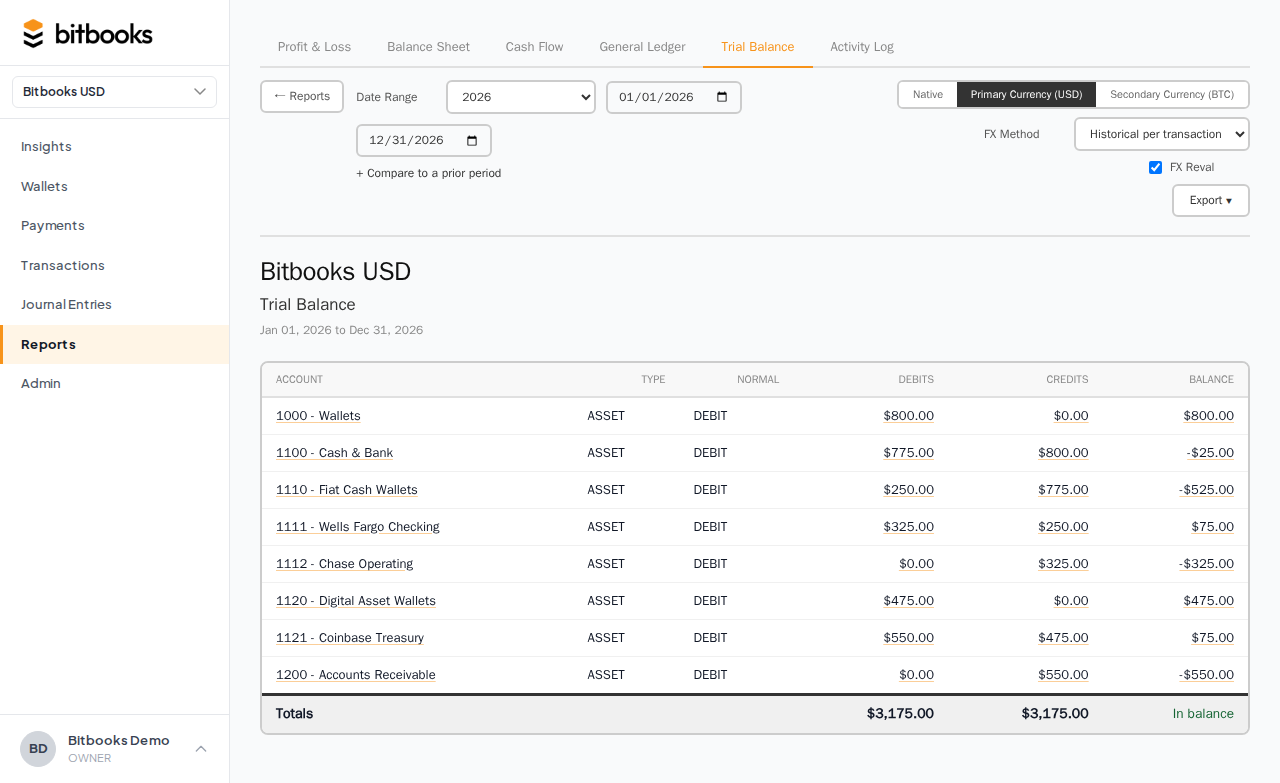
What you see
Every account that has activity in the period appears as a row, grouped by account type:
Assets
  1010 Cash on Hand                          $5,200.00
  1110 BTC Hot Wallet                        $9,000.00
  1115 BTC Cold Storage                     $40,000.00
  1200 Accounts Receivable                   $2,500.00

Liabilities
  2010 Accounts Payable                                  $1,200.00
  2100 Credit Card                                       $   850.00

Equity
  3010 Owner's Capital                                  $25,000.00
  3100 Retained Earnings                                $20,650.00

Income
  4010 Sales                                            $15,000.00

Expenses
  5010 Cost of Goods Sold                    $4,500.00
  6010 Rent                                  $1,500.00

────────────────────────────────────────────────────────────────
TOTAL                                       $62,700.00  $62,700.00
The two totals at the bottom are the answer. They should be equal. Always. If they're not, something is broken.
What "balanced" means
The columns are debits (left) and credits (right). In double-entry accounting:
- Asset and Expense accounts normally carry debit balances
- Liability, Equity, and Income accounts normally carry credit balances
- Every transaction adds equal debits and credits somewhere
If you sold $1,000 of coffee and the customer paid you in cash:
- Cash (Asset, debit) goes up by $1,000
- Sales (Income, credit) goes up by $1,000
Total debits added: $1,000. Total credits added: $1,000. Equal.
Across thousands of transactions, the same rule holds. Adding it all up, the totals should always be equal. The Trial Balance is the proof.
What if the totals don't match?
This should never happen in a working system. Every code path in BitBooks that creates entries enforces the debits = credits rule.
If the Trial Balance is off:
- Don't try to fix the number directly. A "patched" Trial Balance hides the underlying problem.
- Run the Activity Log report to see what was changed recently. Look for entries created or modified around the time the discrepancy started.
- Contact support. Imbalanced books are an integrity issue we want to know about. Send the Trial Balance, the date range, and the difference amount. We'll investigate.
A small rounding difference (a fraction of a cent) is rare but possible due to currency conversion math. Anything more than that is a real problem.
What the Trial Balance does NOT show
- Draft entries. Drafts are excluded from all reports, including Trial Balance. Only Posted, Approved, and Reversed entries appear.
- Future-dated entries beyond the report's end date.
- Archived accounts (unless they had activity in the period).
If a Draft has typos or wrong amounts, the Trial Balance won't surface that. It only checks that posted entries are mathematically consistent.
Trial Balance vs other reports
| Report | What it answers |
|---|---|
| Trial Balance | Are debits = credits? Are the books internally consistent? |
| General Ledger | Every transaction, account by account. The full detail. |
| Profit & Loss | Did we make money this period? |
| Balance Sheet | What do we own and owe at this moment? |
The Trial Balance is the diagnostic tool. The other three are the storytelling tools. You verify with Trial Balance, you communicate with P&L and Balance Sheet.
A quick example: catching an import error
You imported 600 transactions from a CSV file. Everything looks fine on the Transactions page.
You run the Trial Balance. It's off by $847.50.
That tells you exactly one thing: somewhere in those 600 transactions, debits don't equal credits. The CSV file likely had a malformed row, or the import skipped a column, or one of the entries lost a side somewhere.
Without a Trial Balance, you'd have no way to know. Reports would show wrong numbers and you'd never realize it. With a Trial Balance, you catch it in 5 seconds and can investigate.
That's why every bookkeeper runs this report. It's the cheapest insurance there is.
A note for non-accountants
If "debits and credits" sounds like jargon, here's the everyday-life version: it's a way of double-checking your math. Every transaction has two sides because money has to come from somewhere and go somewhere. If you only record one side, the books are broken. If you record both sides, the books work.
The Trial Balance is just the moment where you check that you actually recorded both sides for every transaction.
Where to go next
- General Ledger for the full detail behind any account
- Activity Log to see who recently changed what
- Period Close for locking the books once Trial Balance is clean
- Balance Sheet to see what your business owns and owes